
Most pre-seed founders have no advertising playbook. They run a few campaigns, see mixed results, and assume advertising does not work for their stage. The problem is rarely the channel. It is the absence of a system. Artificial intelligence advertising has given early-stage founders a repeatable framework that did not exist five years ago.
What Most Early-Stage Founders Get Wrong About Advertising
The assumption at pre-seed is that advertising is for later. You need product-market fit first. Ads come after you know what works. That logic is partially right and mostly dangerous.
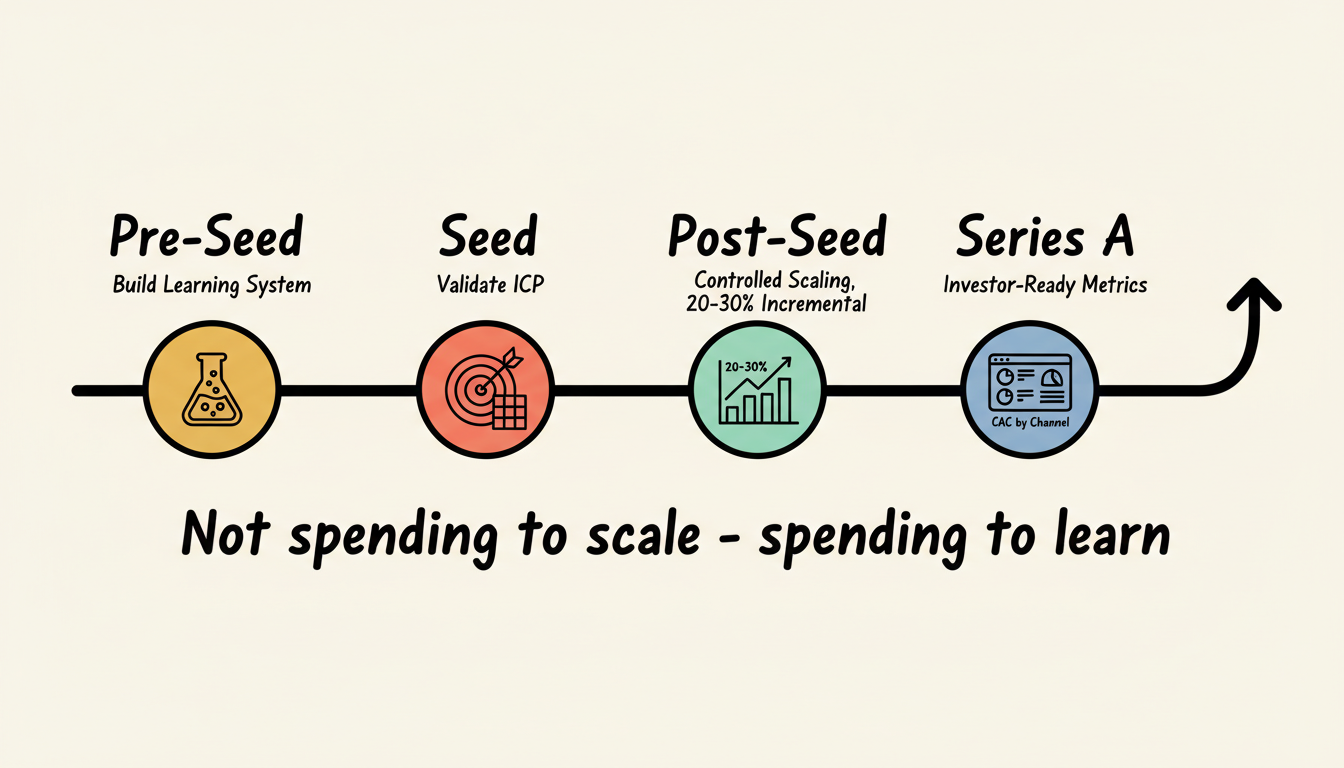
The founders who reach Series A with the strongest metrics started advertising earlier than their peers — not to scale, but to learn. They used paid channels to compress the feedback loop on messaging, audience fit, and conversion rates. By the time they had budget to scale, they already knew what worked.
The playbook is not about spending money early. It is about building a learning system early so that when you do spend, you spend on what works.
The other common mistake is treating advertising as a single-channel experiment. Most early-stage founders pick one platform, run one campaign type, and draw conclusions from too little data. Artificial intelligence advertising frameworks use multi-platform signals to build a more accurate picture of where demand actually lives.
The Seed-to-Series A Advertising Framework
Phase 1: Signal Collection (Pre-Seed to Seed)
At this stage, the goal is not CAC. The goal is signal. You want to understand which audiences respond, which messages convert, and which channels deliver the highest quality traffic.
Run small campaigns across Google, Meta, and LinkedIn simultaneously. Keep budgets tight. Focus on conversion rate by audience segment, not total conversions. This phase is about identifying your real ICP, not proving your growth engine.
Use real-time dashboards from day one. Even small data sets reveal patterns faster when you can see them in real time rather than in a monthly report.

Phase 2: ICP Validation (Seed)
Once you have signal, narrow to your highest-performing audience segment and run structured A/B tests. Test ad creative, landing page copy, and calls to action against that segment.
Continuous testing at this phase means running multiple variations simultaneously, not sequentially. AI-assisted platforms can run dozens of variations at once and surface winners in days, not weeks. Compress the learning cycle as fast as possible.
This phase ends when you have a repeatable conversion rate for your core ICP and a CAC that is defensible against your LTV assumptions.
Phase 3: Controlled Scaling (Seed to Series A)
This is where most founders get in trouble. They see a campaign working and immediately 10x the budget. CAC spikes. ROAS collapses. They conclude that advertising does not scale.
Controlled scaling means increasing spend incrementally — 20 to 30 percent per week — while monitoring CAC in real time. It means expanding to new audience segments only after core segments are saturated. It means maintaining automated budget allocation that pulls spend from underperforming channels and pushes it toward performers.
At this phase, work with an ai advertising agency that understands VC metrics and can translate campaign performance into investor-ready reporting.

Criteria Checklist: What Your Ad System Needs Before Series A
Multi-Platform Coverage
If you are only on one platform, you have audience risk. Your Series A investors will ask what happens if Meta CPMs spike or Google makes a policy change. Multi-platform campaigns answer that question.
Automated Creative Rotation
Manual creative management cannot keep up with fatigue cycles. You need automated testing and rotation that replaces declining performers before they drag down your averages.
Attribution Modeling Beyond Last-Click
Series A decks that use last-click attribution get challenged in diligence. Proper attribution shows the full funnel and makes your CAC calculation defensible.
Real-Time Reporting
Investors at Series A want to see that you manage your growth engine proactively. Real-time dashboards are evidence of operational discipline.
Full-Funnel Strategy
Strategy without execution is a memo. Execution without strategy is wasted budget. Series A requires evidence of both working together, from channel selection through to conversion optimization and reporting. The right ai advertising agency builds these capabilities into every campaign from day one.

Practical Tips for Founders Building the Playbook
Document every test and result. The learning history becomes due diligence material. Investors want to see how your thinking evolved.
Build your CAC model before you scale. Know your target CAC, your acceptable range, and the channels that have historically delivered within that range.
Set up conversion tracking before you spend. Missing data at this stage is unrecoverable. Every unconverted click from a bad tracking setup is a lost learning opportunity.
Treat your first $10K in ad spend as tuition. It buys you data, not customers. Use it to validate assumptions, not to hit revenue targets.
Build investor-ready reporting from month one. A monthly summary showing CAC by channel, trend over time, and budget allocation rationale tells a discipline story that compounds before the raise.

The Competitive Pressure Between Seed and Series A
The startups that raise Series A in your space are already running structured advertising programs. They have test histories. They have multi-platform data. They have real-time dashboards and automated optimization.
If you are still running advertising manually at Seed, you are not just behind on tactics. You are behind on the evidence base investors use to make funding decisions.
The playbook exists. The tools are accessible. The difference between startups that raise and startups that struggle is not budget — it is systems. Build yours early enough to matter.